BUILDING JOB SKILLS BUILDS SOCIAL CAPITAL
Continuing our journey through the five components of the Career Skills and Connections framework, today we discuss Skills Assessment.
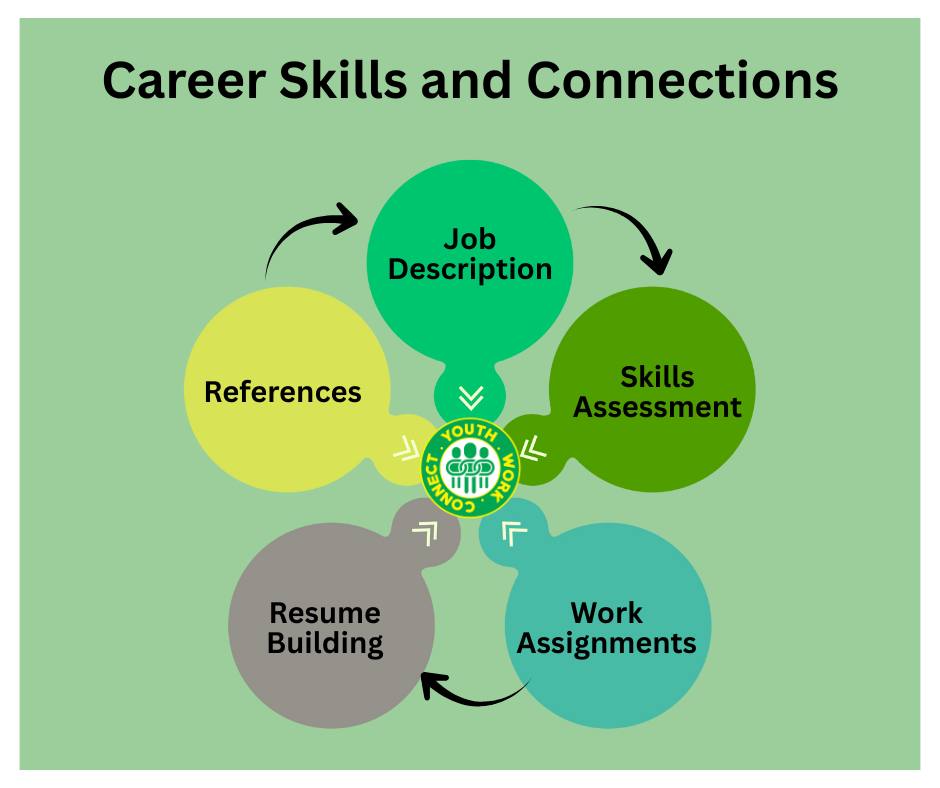
Skills Assessment: identifying strengths and growth areas
When you hire a young person, you take on a big responsibility – you are giving them an early experience to help them learn to become a professional. There is a delicate balance between asking too little and not utilizing the skills the young person brings to the job, and asking too much and leaving them overwhelmed or lost.
A skills assessment is a useful tool for setting expectations and providing support at the right level from day one. The assessment will identify what the young person can do now, what they can do with assistance, and what they need training in.
A practical skills assessment has two parts:
- Power Skills (transferable behaviors)
- Hard skills: what to look for (job-specific)
Hard skills: what to look for (job-specific)
Because hard skills depend on the role, there’s no one-size-fits-all list. But you can use a consistent way to gather evidence. Here are six ideas:
- Portfolio or examples of work: writing samples, designs, projects, or presentations.
- Prior experience + reference: even informal work counts (church, caregiving, coaching, family business).
- Training results: course completion, grades, instructor note, or proof of mastery.
- Certifications: industry or safety credentials.
- Task demonstration: a short, realistic “try-it” task tied to the job.
- Skills-based interview answers: specific examples, not generic claims.
Power skills: what to look for (transferable behaviors)
Hard skills tell you what a young person can do. Power skills tell you how they work-how effectively they apply those hard skills with other people and in real work settings.
At Youth.Work.Connect., we group power skills into four categories: Managing Self, Managing Others, Communication, and Creative & Innovative Problem-Solving.
1) Managing Self
What it covers: willingness to learn, self-awareness, ethical behavior, professionalism, time management, and organization.
Some questions to help with your assessment:
- “Tell me about a time you had to learn something new quickly. What did you do?”
- “When you have multiple responsibilities (school, family, activities), how do you stay organized?”
2) Managing Others
What it covers: teamwork, leadership, project management, helping or arranging training for others.
Some questions to help with your assessment:
- “Tell me about a group project that went well—what did you contribute?”
- “Have you ever helped someone learn something (school, sports, work, family)? What was your approach?”
3) Communication
What it covers: active listening, writing, oral communication, and equity & inclusion (listening to and taking account of others’ opinions and expertise).
Some questions to help with your assessment:
- “Explain something you’re good at to me like I’m new to it.”
- “Tell me about a time you worked with someone different from you. What helped it go well?”
4) Creative & Innovative Problem-Solving
What it covers: creativity and imagination, critical thinking, analyzing and drawing valid conclusions from data, and learning to partner with a digital world.
Some questions to help with your assessment:
- “If you didn’t understand a task, what would you do?”
- “Tell me about a time you used technology to solve a problem or improve something.”
Once you have a clear picture of a young person’s hard and power skills, you can set realistic expectations, provide assignments they can succeed in, and build a plan that helps them learn.
What’s On Our Mind- Building Workforce Pathways
At Youth.Work.Connect. (YWC), February has been an exciting and purposeful month as we celebrate Career Technical Education (CTE) Month and the powerful impact of workforce-readiness programs for our youth.
In this new role, I’ve had the privilege of meeting with incredible community leaders who are already doing transformative work with young people across our region. Each conversation has centered on one powerful question: How can YWC partner and share in the great work that’s already happening?
I’m grateful for the opportunity to make meaningful introductions and begin building bridges between schools, employers, and community organizations. These connections are the foundation for expanding work-based learning opportunities for students.
Two of the partnerships we are developing are with:
- Durham Youth Works Program
and
- Thomas Leadership Mentoring Academy
The Work Continues
The search continues for business, community, and civic organizations that desire to strengthen their programs and help build a stronger workforce pipeline.
If your organization is passionate about:
- Expanding work-based learning
- Supporting internships and apprenticeships
- Mentoring the next generation
- Creating equitable career access
Let’s start the conversation.
Together, we can build strategic alliances that open doors, increase exposure, and create sustainable workforce development opportunities for students.
Antoinette Daye, Executive Director, Antoinette_Daye@youthworkconnect.org
LET’S STAY CONNECTED
We would appreciate your thoughts on our initiative and welcome opportunities to collaborate. You can reach us at info@youthworkconnect.org and we look forward to staying connected.